Physical Evidence Catalog
The Council retains a limited collection of trace material associated with reported activity. Inclusion in the catalog records provenance and custody only; it does not establish origin. Samples are not assigned to Gobelinus galliformis unless an independent basis for attribution exists.
Evidence handling standard
Field material is photographed in place where possible, assigned a catalog number, sealed separately, and transferred with a signed custody sheet. Comparison material from the same site is collected when practical. Items with uncertain collection history remain in the archive but are excluded from evidentiary summaries.
| Catalog | Material / source | Collected | Custody | Analysis status |
|---|---|---|---|---|
| EV-0348-A | Original cassette field recording associated with repeat-site watch, Carbon County, PA. Seventeen-minute segment contains three separated whistle sequences and intermittent low clicking. | 22 Sep 1994 | Original cassette sealed; preservation copy made 2008; 24-bit digital transfer completed 2023. | Reviewed by two independent audio technicians. No source attribution. Environmental contamination significant. |
| EV-0399-C | Fractured plaster cast recovered from a short series of ground impressions beneath a creek crossing near Bangor, PA.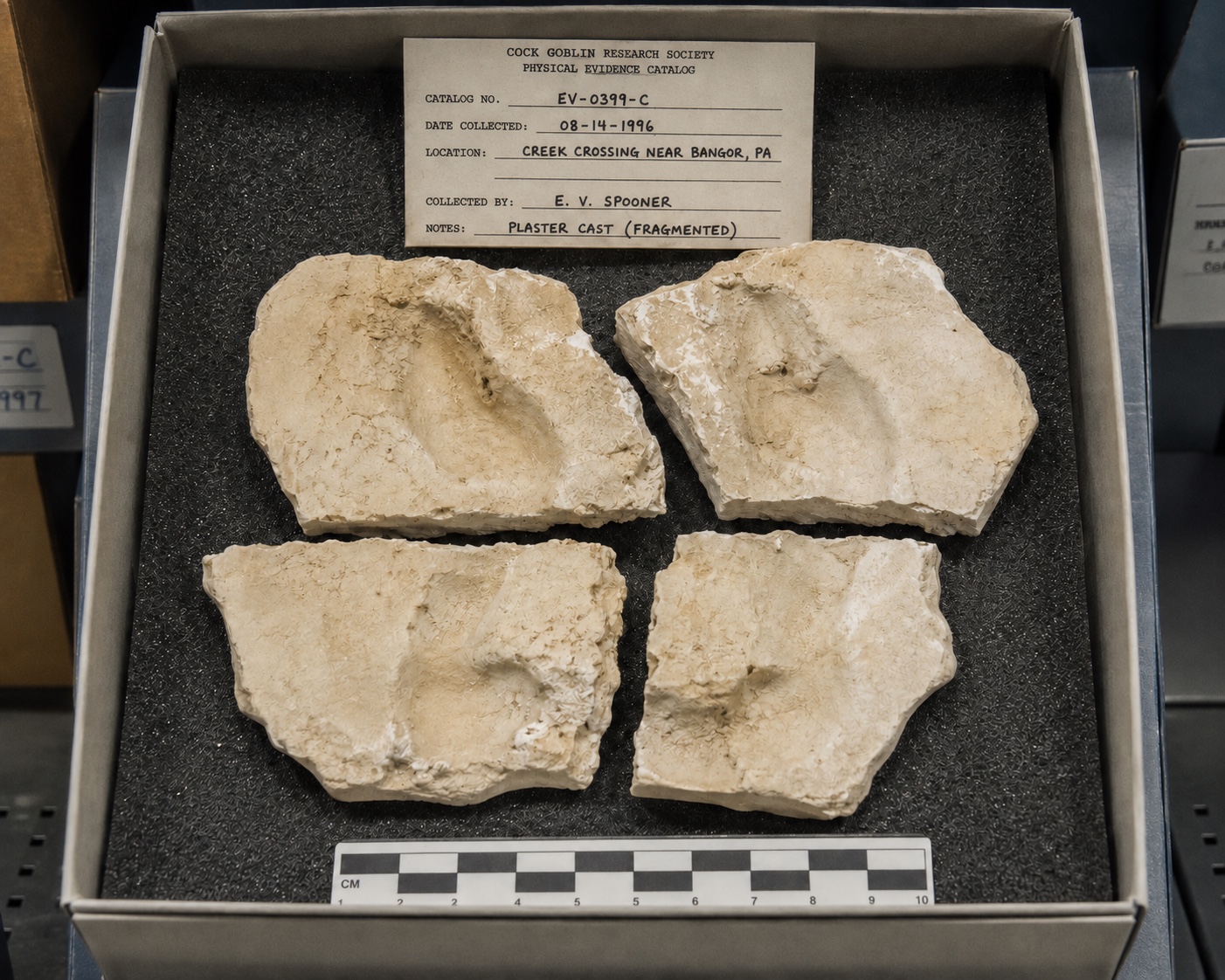 | 14 Aug 1996 | Cast fractured during return transport. Four fragments retained in padded archival box; field photographs preserved separately. | Measurements recoverable only in part. Comparative review inconclusive; no current plan for destructive testing. |
| EV-0529-S2 | Soil retained from the margin of three impressions beneath a municipal footbridge, Scranton, PA, with adjacent control sample. | 02 Oct 2003 | Two sealed glass containers; seals replaced under witnessed transfer in 2017 after original adhesive failure. | Mineral and organic profile consistent with local bank soil. No diagnostic material identified. |
| EV-0726-A | Unedited residential audio file containing low clicks followed by three spaced whistles on two consecutive nights, Bethlehem, PA. | 30 Aug 2013 | Original recorder card imaged by Council; checksum recorded. Witness retains original device. | Timing verified. Known bird, vehicle-alarm, and common mechanical sources not matched; source unresolved. |
| EV-0751-C | Two partial casts from drainage-ditch impressions, Sussex County, NJ. Field conditions deteriorated during collection. | 12 Oct 2014 | Retained by Northwestern New Jersey Chapter until 2019; transferred to National Archive with complete chapter custody log. | Independent reviewer declined source classification because impression edges were degraded before casting. |
| EV-0839-S1 | Paired soil and vegetation-contact samples from two observation points along the Wilkes-Barre drainage corridor. | 23 Nov 2019 | Frozen within six hours of collection; transferred to controlled storage the following day. | Routine environmental profile completed. No unusual chemical finding. Retained as site-control material. |
| EV-0914-F1 | Hair/fiber bundle recovered near crawlspace access after repeated scratching complaints, Reading, PA. | 08 Jun 2022 | Primary packaging was compromised by water intrusion during vehicle transport on 09 Jun 2022. Item resealed and marked compromised. | Laboratory comparison discontinued because custody conditions no longer supported exclusionary analysis. Retained for record only. |
| EV-0948-R1 | Unidentified fiber recovered from chain-link boundary at a repeat utility-corridor site, Warren County, NJ. | 04 Mar 2024 | Collected with sterile forceps; field blank retained; sealed under dual signature. | Microscopy identified mixed natural and synthetic material. Sample insufficient for reliable source determination. |
| EV-0992-S3 | Surface-soil control series from the current Northampton County repeat site; collected to compare later trace submissions against known background material. | 31 Jul 2026 | Active-file evidence locker; access limited to assigned review team. | Baseline profile complete. No attribution intended; retained for comparison during active review. |
Storage and testing policy
The National Archive holds twenty-four plaster casts, four sealed containers awaiting re-review, the soil controls, the original media, and a number of samples that were compromised at some point and are kept anyway. All of it sits under separate inventories, for reasons that were sound in 1989 and are now simply how it is.
Where money and sample condition allow, analysis goes to a laboratory outside the collecting chapter. A laboratory reporting "unidentified" has told us that it could not identify something. It has not told us that the something is unidentifiable, and members who quote it the second way are asked to stop.
Destructive testing needs Methods Committee approval, enough material left over afterwards, a specific comparative question written down in advance, and a laboratory prepared to document what it did. In thirty-seven years this has been granted four times.
Related records
For site narratives and witness classifications, see Documented Encounters. For custody sheets, field notes, and released record excerpts, see the Document Archive. Current handling standards are summarized in Field Research.
Catalogue current to 14 February 2026. Custody column is authoritative; the notes column is not.